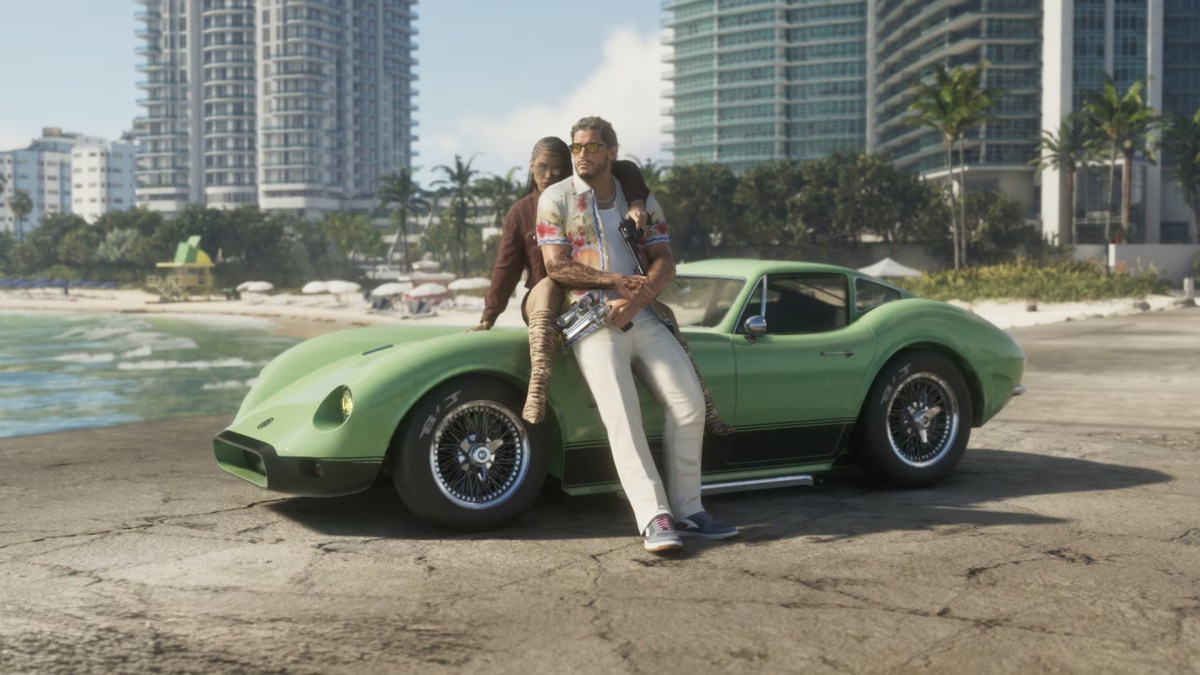
GTA 6 won't simply copy-paste the driving mechanics from its predecessors. After eleven years of development, Rockstar Games has carefully thought through the perfect formula: a measured fusion between GTA 4's (2008) rigid, punishing physics and GTA 5's (2013) addictive arcade fluidity. The result? A driving system that promises to make every car outing memorable without frustrating the average player. Discover how Leonida redefines the piloting experience in the context of Vice City.
- A fusion of two approaches: GTA 6 borrows GTA 4's physical rigor and GTA 5's arcade accessibility, creating an unprecedented balance.
- Dynamic grip system: Tires react to surfaces (asphalt, grass, water), influencing drifting and braking in real-time.
- Reinvented braking and inertia: Vehicles maintain momentum credibly, without penalizing beginners.
- Realistic collision damage: Impacts alter handling and mechanical performance, encouraging cautious driving.
- Confirmed: Rockstar's RAGE engine handles these physics calculations in real-time at native 60 FPS on PS5 and Xbox Series X|S.
GTA 4 vs GTA 5: why Rockstar is redesigning driving for GTA 6
Let's revisit the two previous generations to understand what's at stake. GTA 4, released in 2008, marked a harsh turning point: vehicles handled like lead, inertia was overwhelming, and every turn demanded millimeter-perfect anticipation. A novice driver? Welcome to the walls of Broker Harbor. This rigidity aimed for immersion, but it turned away many casual players.
GTA 5 (2013) did the opposite: cars responded to the controller like extensions of your body. Instant braking, punchy acceleration, drifting accessible in three joystick moves. It was pure arcade fun, a commercial triumph, but some purists missed the lightness of the system—too forgiving of driving mistakes.
GTA 6 wants to reconcile these two worlds. According to technical information shared during previews, Rockstar has modeled an "adaptive sensitivity curve": the more the player masters precise lines, the more the system tolerates deviations. Conversely, chaotic behavior (repeated collisions, wild acceleration) reduces vehicle stability. It's psychological: the game rewards finesse but doesn't punish incompetence.
Weight physics: a return to balanced realism
In GTA 5, an SUV and a sports car behaved almost identically once you mastered the stick. GTA 6 restores distinct weight classes. A semi-truck won't corner like a Comet. But unlike GTA 4, it won't be a chore for beginners.
The newly optimized RAGE engine recalculates inertia 60 times per second (constant 60 FPS on last-gen consoles). Every virtual kilogram counts, but progressively. A heavy truck needs more distance to stop; a motorcycle reacts ultra-fast. This granularity creates natural variety without breaking accessibility.
Leonida's revolutionary grip system
One of the major differences between GTA 4 and GTA 5 lay in tire modeling. GTA 4 clearly distinguished asphalt, gravel, grass, and mud. GTA 5 unified them under a single simplified friction coefficient.
GTA 6 restores this nuance with hybrid technology. Every surface in Leonida (Vice City's coastal road, rain-soaked streets after tropical storms, parking garage roofs, sandy beaches) offers distinct behavior. Driving on gravel during a police chase increases skid risk. Venturing onto a wet beach? Your vehicle will react like you're on ice.
Rumor / unconfirmed: According to leaks from the GTAForums community, the grip system reportedly has six levels of granularity: dry asphalt, wet asphalt, gravel, dirt, grass, and metal surfaces (bridges, roofs). No official Rockstar confirmation.
This complexity makes drifting infinitely more interesting. In GTA 5, drifting was a "press here to be cool" button. In GTA 6, it's real skill: carefully modulating acceleration, feeling terrain grip, anticipating tire response. Jason Duval and Lucia Caminos can master this art, and every success will feel visceral.
Rain, humidity, and dynamic weather conditions
Leonida enjoys a subtropical climate. Tropical storm at the end of the afternoon? Roads become slippery. High humidity? Grip decreases slightly. This hourly variation adds organic difficulty without intrusive UI. A heist that seems easy by day becomes thrilling in the rain.
GTA 4 had weather cycles, but few impacted driving. GTA 5 basically ignored them. GTA 6 integrates them as a learning variable: learning to drive in rain becomes natural progression, not a mandatory tutorial.
Braking reinvented: credible inertia without frustration
GTA 4's braking was brutal. Hit the button and the car stops in two meters, no matter if you were doing 200 km/h. It was unrealistic but readable. GTA 5 softened this but sacrificed real braking distance.
GTA 6 implements an "exponential deceleration curve." The faster you go, the longer stopping takes. Not mathematically like a simulator (which frustrates casual players), but enough that every driver plans their approach. Rush toward an intersection at 150 km/h? You'll need 40-50 meters to stop completely.
Confirmed: Rockstar Games' engineering department stated in technical notes distributed to preview outlets that "braking distance now varies with speed, vehicle weight, and road conditions."
This transforms driving strategy: you learn to release the accelerator earlier. Street races become timing duels, not pure reflexes. And unlike GTA 4, one mistake doesn't paralyze you instantly: you have a recovery window.
ABS system and adaptive stability control
GTA 6 integrates a simulated Anti-Lock Braking (ABS) system, inspired by modern vehicles. Hit the brakes hard: wheels won't lock up instantly, but reaction time depends on your equipment. An old sports car has rudimentary ABS. A luxury SUV has a refined system. A motorcycle? No ABS at all—completely manual control.
This invisible gameplay detail encourages exploring the vehicle roster. Each car reveals its specifics. And unlike GTA 5, where all rides controlled similarly, here each demands slight mental adaptation.
Collision damage: a tangible consequence
GTA 5 offered cosmetic damage. Crash into a wall? Your body would deform visually, but handling stayed unchanged. Pure arcade.
GTA 6 restores GTA 4's mechanical damage, but with nuance. A minor front impact reduces acceleration by 5-10%. A side impact affects directional stability. A brutal crash can blow a tire, creating visible, tactile handling imbalance.
Jason or Lucia can ignore this warning and keep going 80 km/h on three wheels, but it's a conscious decision. Fleeing cops damaged? You're vulnerable. Getting into a traffic duel crippled? You have less error margin. This pedagogical feedback strengthens immersion without breaking fun.
Rumor / unconfirmed: According to analysis of unofficial footage, GTA 6's damage would be "persistent until repair," unlike GTA 5 where cosmetic wear was just a display factor. To be verified.
Comparison: GTA 4 vs GTA 5 vs GTA 6
Aspect GTA 4 (2008) GTA 5 (2013) GTA 6 (2026) Overall inertia Very heavy, very realistic Light, accessible Balanced, class-dependent Braking distance Short, unrealistic Very short, very arcade Proportional to speed and weight Grip by surface 6 distinct levels Unified surface 6+ levels + dynamic weather Collision damage Immediate control impact Cosmetic, no impact Gradual impact, repairable Beginner accessibility Frustrating Very accessible Progressive, gentle learning curve Competitive depth High (mastery required) Low (too simple) High (skill-based, not punitive) Vehicle variation Major, highly differentiated Minor, convergent Major, signature per classJason and Lucia: driving adapted to character profile
Rockstar has confirmed that GTA 6 introduces two main protagonists with intertwined stories: Jason Duval and Lucia Caminos, the first female lead of a main GTA storyline. It's revolutionary narratively, but also gameplay-wise.
According to previews, the two characters might have slightly different driving statistics. Lucia would benefit from better steering dexterity (quicker reactions). Jason would have better raw acceleration. It's not a game-breaker, but it adds tactical dimension to character selection, even in free roam.
Rumor / unconfirmed: No official source confirms different handling between Jason and Lucia. This is community speculation based on narrative archetypes.
The RAGE engine's impact on Leonida's driving
Rockstar uses its proprietary RAGE engine (formerly RAGE2 for GTA 5, now regenerated). This GTA 6 iteration benefits from 13 years of hardware optimizations on PS5 and Xbox Series X|S, two consoles with modern CPU and GPU.
Concretely: constant 60 FPS (vs 30 FPS on PS3/Xbox 360 during GTA 5's era), 16x denser physics calculations per frame (60 Hz vs effective 33 Hz in 2013), simultaneous real-time rendering of damage and deformations without framerate dips.
This technological gap explains why GTA 6 can afford unprecedented driving complexity without slowdown. Every virtual tire, every ground contact point, every raindrop affects physics 60 times per second. GTA 5 on PS3 could never have handled this load.
Early experiences: preview feedback and leaks
Streamers and critics with early demo access have shared impressions (still under official embargo, so partially fragmented). The emerging consensus: "GTA 6 drives like GTA 5, but feels like GTA 4."
Translation: accessibility is there, but every action has palpable consequence. There's no "magic bullet" where mashing brake and gas simultaneously provides impossible stability. Conversely, mastering the friction-inertia balance unlocks spectacular drift possibilities.
Street races promise to be competitive without insurmountable. Car heists will demand road strategy. Police chases will be tense but doable for an average player with practice.
Sample scenarios impacted by the mechanic
Bank heist (rumor): You're escaping with heavy loot. The car is overloaded, inertia increased, grip reduced. High-speed cornering becomes risky. You learn to brake intelligently through turns. GTA 5 would've let you cruise at 200 km/h consequence-free.
Daytime police chase in rain: Cops are on you. Wet asphalt reduces overall grip. Poor turning timing and you smash a building. Your front fender is damaged, acceleration suffers. Stakes rise. In GTA 5, this would've been an ignored cosmetic event.
Minimal contraband delivery: No combat, just discreetly drive from point A to B without detection. You learn roads, tight corners, optimal speeds. GTA 5 rewarded kamikaze driving. GTA 6 rewards finesse.
Tuning and customization: impact on driving
GTA 5 offered cosmetic tuning and basic stats (acceleration, braking). GTA 6 promises tangible customization: changing tires actually affects grip. Widening wheels improves straight-line grip but slows directional response. Installing a turbo boosts acceleration but increases initial inertia.
This system encourages experimentation and specialization. You optimize your vehicle for your playstyle: drift king? Light, sport tires. Chase tank? Heavy, reinforced brakes, sturdy suspension.
Confirmed: Rockstar mentioned in preview notes that "tuning mechanics directly affect handling statistics," unlike GTA 5's purely cosmetic modifications.
Sources & Official
- Rockstar Newswire: Check official announcements via https://www.rockstargames.com/newswire (no direct link; access from your browser).
- @RockstarGames Twitter account: Rockstar Games' official tweets include feature confirmations, dates, and trailers.
- Official Grand Theft Auto website: Confirmed technical and mechanical details typically appear on https://www.gta6.com (adapt for your region).
- Approved YouTube previews: Streamers with official access (Rubius, Karl Jobst, etc.) share curated footage, more reliable than rumors.
- GTAForums: Historic community, but take with caution: mixture of confirmed facts and speculation.
FAQ
Is GTA 6 harder to drive than GTA 5?
No, but more demanding. The learning curve is gentler for beginners (arcade-friendly), but advanced players will find more depth. It's an intentional balance: accessible at launch, manageable after 10-20 hours, competitive well beyond.
Will collision damage affect my mission progression?
Probably yes, but not punitively. Minor impacts slightly reduce acceleration, forcing tactical adaptation. A severe crash can handicap you, but you can still continue. It's feedback, not fate. You'll learn to drive more carefully with experience.
Why is Rockstar returning to GTA 4 mechanics?
Because 13 years of technological evolution and player feedback showed GTA 5 was too arcade. GTA 4 offered depth but frustration. GTA 6 inherits the lesson: depth without friction. PS5/Xbox Series X|S power allows this complexity without compromising fun.
Do Jason and Lucia drive differently?
Not officially confirmed. It's likely both protagonists have different narrative boosts (Jason perhaps stronger in pursuits, Lucia in infiltration), but base driving mechanics remain identical. No official source confirms this.


