Leonida's Hurricanes: When Rockstar Transforms Weather into Game Mechanics
Since the beginning of the Grand Theft Auto franchise, weather has always been nothing more than a cosmetic element: rain that doesn't wet anything, fog that barely impairs visibility, storms with no consequence on vehicles or world physics. With GTA VI, the accessible data and analysis of trailers strongly suggest that Rockstar is considering a radically different approach. Florida, the direct inspiration for Leonida, is synonymous with one thing: tropical hurricanes. These categorical weather phenomena cannot be ignored in a simulation that respects the geographic and cultural setting.
The RAGE engine, completely rethought for GTA VI, integrates rendering and simulation systems far more sophisticated than its previous iterations. The central question, then, is not whether dynamic weather will exist, but how it will impact gameplay, driving, combat, and overall immersion. This article explores, based on visual clues from the trailers and confirmed technical architecture, what a living weather system might represent in Vice City.
Confirmed Weather and Visual Clues from Trailers
The first official GTA VI trailer, revealed in December 2023, clearly showed sequences in heavy downpours. These images are not incidental: they reflect a visual and atmospheric priority for Rockstar. The reflections on wet roads, neon lighting refracted through water, and character movements under showers indicate significant work on weather dynamics.
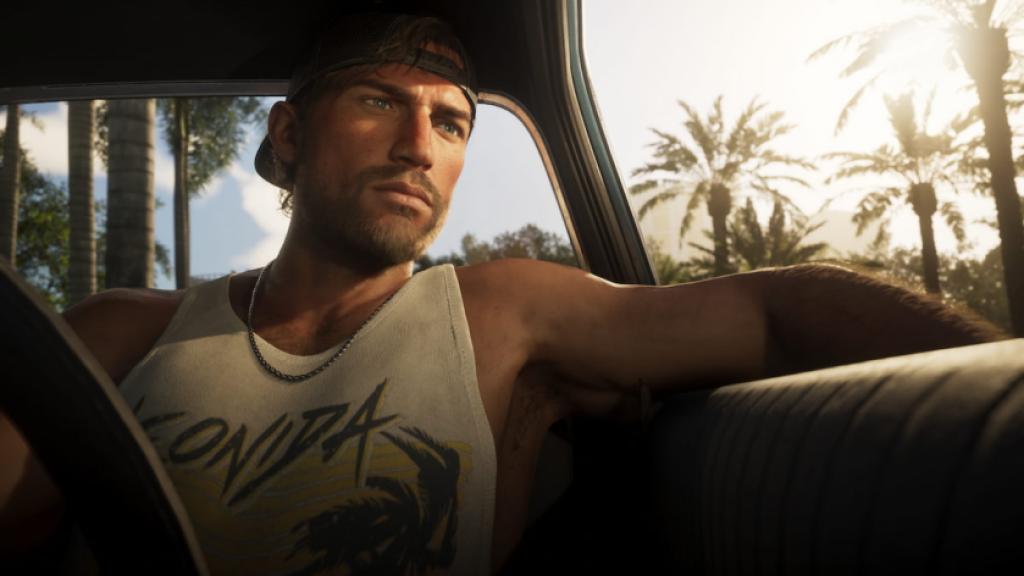
The two protagonists, Jason Duval and Lucia Caminos, were filmed in varied weather conditions: the characteristic bright sunshine of Miami, but also gray skies, stormy lighting, and complex atmospheric gradations. This visual variety in the trailers is never accidental: it signifies that the developers deliberately showcased the meteorological diversity available in the game.
The geographic context confirms this direction as well. With Leonida inspired by Florida, it would be impossible for a game claiming simulated realism not to offer a tropical storm system. It's a pillar of the region's climatic identity, just like the sun and omnipresent humidity.
Technical Architecture: How the RAGE Engine Handles Weather Phenomena
The RAGE engine used for GTA VI has been modernized compared to its previous versions (most recently GTA V in 2013). Available technical confirmations indicate a substantial overhaul of rendering, AI, and physics simulation systems.
Dynamic Rendering and Cloud Volumetrics
Modern clouds and atmospheric formations in game engines are generated via techniques like volumetric ray marching or screen-space rendering. These approaches enable dense, three-dimensional clouds that interact realistically with global lighting. With partial ray tracing confirmed for GTA VI (at least on next-gen consoles), developers can create stormy skies where sunlight or streetlamp light refracts through layers of rain and fog.
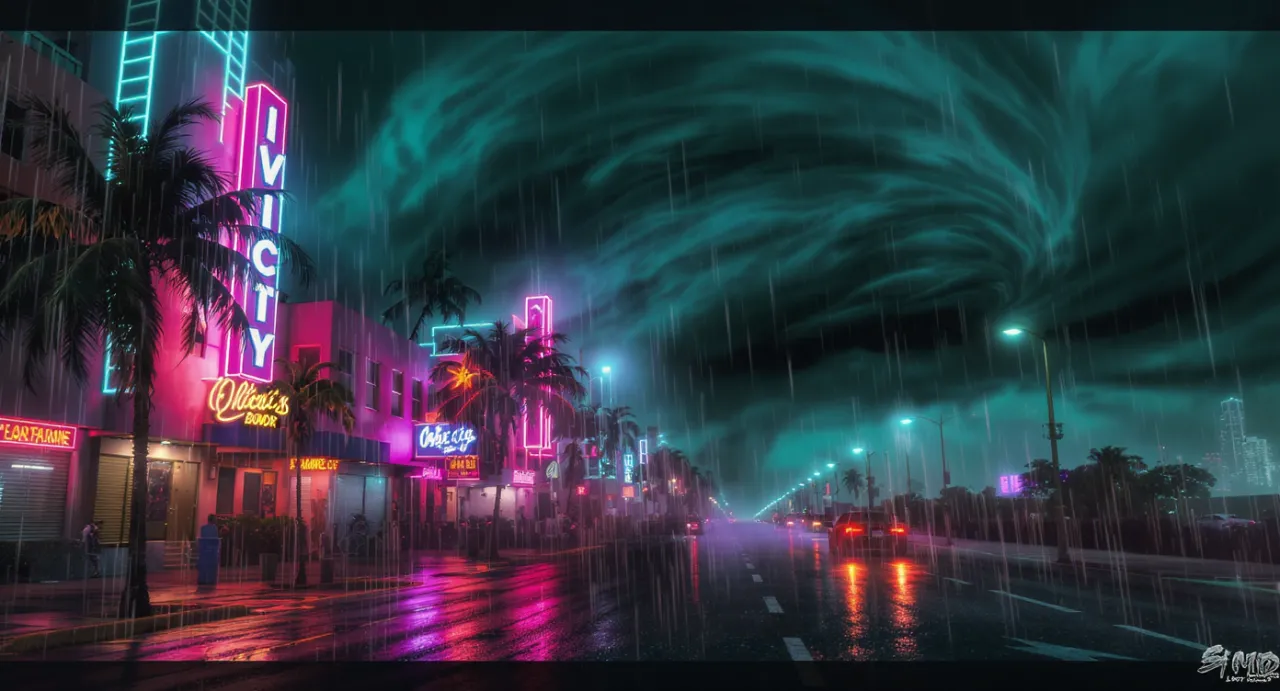
Volumetric rendering also provides an enormous sense of depth: a hurricane approaching on the horizon shouldn't look flat or painted. It must have an overwhelming, threatening presence that progressively changes the game's sky as the player approaches it or moves away.
Vehicle Physics During Storms
This is where weather becomes a true game mechanic. GTA VI's physics system, managed by the enhanced RAGE engine, must integrate environmental forces: powerful lateral wind, reduced tire grip, and visibility reduction due to torrential rain. Driving a lightweight sports car in a hurricane becomes a control challenge, while a heavy truck remains relatively stable but drastically reduces visibility.
Suspension and shock absorption systems must also respond to conditions: on wet roads, vehicles skid more easily, braking is less effective, and high-speed turns become deadly dangerous. This is an opportunity for Rockstar to add contextual difficulty without relying on artificial parameters.
Day-Night Cycle and Weather Transitions
GTA V already offered a day-night cycle and weather transitions, but on a simplified system. GTA VI's RAGE engine can support gradual and fluid transitions: clear skies that slowly darken, clouds that accumulate, then rain that starts timidly before exploding into a tropical deluge. These transitions aren't instantaneous; they last minutes of game time, creating heightened anticipation and immersion.
According to unconfirmed rumors circulating in the community, GTA VI might even feature a semi-persistent weather system: a storm that arrives in a given region stays there for elapsed game time, affecting missions, side activities, and driving across multiple day-night cycles. This would contrast sharply with GTA V, where weather changes were almost random and lacked narrative continuity.
Hurricanes as Dynamic and Immersive Events
Progressive Arrival Mechanics
A hurricane doesn't strike instantly: it arrives, threatening. The system envisioned for GTA VI could integrate progressive visual warnings. On the horizon, a wall of clouds accumulates. Wind strengthens imperceptibly. Leaves and debris begin to swirl. The sky shifts from blue to gray to black. Then, suddenly, the first torrential gusts strike.
During this phase, NPCs react: they run for shelter, shops close, streets empty. Poorly parked cars can be overturned or damaged. Advertising signs come loose. It's a cascade of visual and physical events generated in real-time by the engine, creating a sense of urgency and immediate danger.
Impact on Missions and Gameplay
Unconfirmed but highly probable: hurricanes could affect certain missions. Imagine a chase mission where you must maintain control of a car amid devastating side gusts, or a sniper mission where rain reduces your accuracy. Water-based missions (boats, jet-skis) could become outright impossible during a storm, forcing the player to postpone or adapt their strategy.
This approach would transform weather from a simple cosmetic element into a tactical obstacle, reinforcing immersion and the sense that Leonida is a living, unpredictable, sometimes hostile world.
Environmental Destruction and Dynamic Damage
Hurricanes cause real damage. GTA VI's RAGE engine, with its improvements in environmental destruction, could integrate destructible storm damage: windows that explode, structures that partially collapse, flooded roads becoming impassable. This damage wouldn't be scripted but generated by the physics simulation itself.
This creates different contexts for each hurricane passage. A building could be damaged one way during an initial storm, then differently during a subsequent one. This emergent variation massively increases replayability and reinforces the feeling that the world isn't predetermined.
Audio Systems and Sensory Immersion
Audio is often overlooked when discussing dynamic weather, yet it's crucial for immersion. A hurricane must sound devastating.
Progressive Sound Design
As a storm approaches, ambient sound must evolve: wind shifts from gentle to deafening, rain changes from crackling to continuous deluge. Inside a building, sound dampens but remains oppressive. If you're in a car, wind howling against the chassis, rain pelting the roof, and distant thunder rumbling create a visceral atmosphere.
Character dialogue could also adapt: they'd shout to be heard over the storm, use shorter and more urgent phrases. It's a detail many games ignore, but one that makes an enormous difference to immersive coherence.
Dynamic Thunder and Lightning
Thunder isn't just noise: it's also a light source. Lightning illuminates the sky and landscapes in real-time. Coupled with partial ray tracing, this creates dramatic moments where Leonida's entire geography is briefly illuminated by blinding white flashes, followed by near-total darkness before the storm darkens again.
These dynamic lighting effects aren't cosmetic: they also affect player visibility, complicating navigation and creating additional tension.
Comparison with GTA V: Evolution and Break
GTA V (2013) offered basic weather: rain, fog, very rarely snow. These conditions changed quickly, without much transition, and had little mechanical impact on gameplay. A driver in rain and a driver in clear weather controlled their vehicle almost identically. The system was primarily visual and atmospheric.
GTA VI appears to aim for a major break. Weather won't just be beautiful to look at; it will be a force that shapes gameplay. This is an evolution comparable to what racing games (Forza, Gran Turismo) have integrated: weather isn't a handicap, it's a system.
This leap forward also reflects GTA VI's overall ambition: not a simple visual refresh of GTA V, but a fundamental overhaul of how the world interacts with the player.
Unconfirmed Rumors and Community Debates
Several speculations circulate in the GTA VI community, without official confirmation. It's important to distinguish these from facts:
- Named and Predictable Hurricanes: rumor that hurricanes could have a predictable timeline (arriving at certain game periods) or be named. Unconfirmed.
- Storm Seasons and Annual Cycle: speculation that GTA VI might feature seasons with more frequent hurricane periods (summer/fall) and quieter ones. No confirmation.
- Emergency Shelters and Survival Missions: community debate about the possible existence of refuge zones or missions where you must survive a storm. Unconfirmed.
- Coastal Zone Evacuations: speculation that coastal areas could be partially evacuated during impending hurricanes. No official source.
These rumors remain hypotheses based on narrative logic and technical potential, not Rockstar announcements.
Impact on Performance and Optimization
Simulating complex dynamic weather is resource-intensive. Volumetric rendering of dense clouds, dynamic lighting effects, wind physics, and real-time generated environmental damage represent a significant GPU and CPU load.
Rockstar has confirmed that GTA VI will run at 60 fps on PS5 and Xbox Series X|S in performance mode. This means weather systems must be optimized to not compromise smoothness. The enhanced RAGE engine is supposed to handle this through advanced optimization techniques (aggressive culling, intelligent LOD, data compression), but it's a delicate balance between visual ambition and technical stability.
On PC, whose specifications aren't yet confirmed, weather could be pushed further: more rain particles, full volumetric ray tracing, or greater environmental destructibility.
FAQ: Frequently Asked Questions About GTA VI Weather
Will GTA VI's Weather Really Affect Driving and Gameplay?
It's highly probable but not formally confirmed by Rockstar. The trailers clearly show varied weather conditions, and the geographic context (Florida) demands robust systems. Improvements to the RAGE engine and physics systems suggest deep integration of weather into mechanics, unlike GTA V where it was mostly cosmetic. It's reasonable to expect real impacts: reduced grip, diminished visibility, wind forces.
Will There Be Realistically Categorized Hurricanes?
No official announcement confirms a Saffir-Simpson scale or realistic hurricane categorization. It's logical speculation: if Rockstar simulates tropical storms, classifying their intensity would make gameplay more nuanced. However, absent evidence to the contrary, this remains community debate, not a confirmed feature.
Will Weather Affect Missions or Side Activities?
Unconfirmed, but logically probable. Imagine certain water missions being blocked during storms, or illegal races becoming more dangerous in torrential rain. It's a rational narrative and mechanical use of dynamic weather. However, we don't know for certain whether Rockstar implements this systemic depth.
Will GTA VI Have Seasonal Cycles or Just Random Weather?
GTA V used a partially scriptable but largely random system. GTA VI might evolve toward a semi-persistent system with cycles or scheduled weather events, but this hasn't been confirmed. The trailers don't show enough temporal context to assert that genuine seasonal progression exists in Leonida.