Ray-tracing in GTA 6: The future of photorealism begins in Leonida
Since GTA VI's official announcement in December 2023, one question has dominated the fan community: how will Rockstar Games push the boundaries of visual realism on PS5 and Xbox Series X|S? The answer comes down to three words: advanced ray-tracing. While Rockstar hasn't released exhaustive technical specs, official trailers and partial confirmations reveal an unprecedented graphical ambition, where every light ray contributes to creating the perfect illusion of Vice City and Leonida.
Ray-tracing itself isn't technologically new—studios have deployed it since 2018—but its integration into GTA 6 marks a turning point. Why? Because Rockstar combines this technology with a massive map, extreme urban density, and a completely recalibrated RAGE engine built for 2026. It's the perfect convergence: sufficient computational power (PS5, Xbox Series X), precise artistic vision, and years of R&D.
What is ray-tracing and why is it crucial for GTA 6?
The fundamentals: real-time light simulation
Ray-tracing is a rendering technique that simulates the physical behavior of light. Instead of placing "fake" lights in a scene (traditional rasterization), ray-tracing fires millions of virtual rays that bounce between surfaces, creating reflections, refractions, and incredibly realistic shadows.
Picture a scene in Vice City: a tropical sunset reflects off a window pane, then off a car's wet paintwork, then into a puddle. With rasterization, each element is a separate trick. With pure ray-tracing, it's physically accurate. That sunset's real light bounces exactly as it would in the real world.
Why GTA 6 needs ray-tracing
- Urban immersion: Vice City and Leonida are ultra-detailed environments where every surface matters. A skyscraper window, a puddle in an alley, motorcycle chrome—everything must reflect and interact with light convincingly.
- Narrative atmosphere: GTA 6 is presented as a dark, atmospheric experience. Ray-tracing enables nuanced shadows, dramatic backlighting, visual depth that amplifies cinematic immersion.
- Technical performance: with real-time shadows and dynamic reflections, Rockstar reduces visual "cheating" and redirects more power toward gameplay, NPC AI, and emergent systems.
The RAGE engine optimized for GTA 6: architecture and hybrid ray-tracing
RAGE 2026: not a revolution, a calculated evolution
Rockstar confirmed that GTA 6 runs on the RAGE engine, the same one as GTA 5. But this isn't the 2013 RAGE. After 13 years of iteration, the engine has been rigorously restructured to exploit the modern architecture of PS5 and Xbox Series X (custom AMD processors, ultra-fast SSD, RDNA 2 GPU compatible with ray-tracing via DirectX 12 Ultimate and AMD extensions).
The improvements confirmed or strongly suggested by trailers include:
- Hybrid ray-tracing: not 100% pure ray-tracing (too costly for an open-world this size). Instead, Rockstar combines selective ray-tracing (reflections on water, storefronts, chrome) with optimized rasterization for everything else. It's the strategy of all modern AAA titles, and notably what GTA 5 did with ray-traced reflections in PC updates.
- Real-time global illumination: shadows and indirect light are recalculated each frame, creating light coherence no previous GTA version has achieved.
- RDNA 2 shaders: native optimization for current console GPUs, reducing bottlenecks.
- Aggressive SSD streaming: Vice City and Leonida are enormous. The custom SSD in new-gen consoles enables real-time texture and geometry streaming, essential for maintaining ray-tracing without performance loss.
Confirmed and unconfirmed performance details
Confirmed fact: GTA 6 launches November 19, 2026 on PS5 and Xbox Series X|S in Standard ($79.99) and Ultimate ($99.99) editions. No PC version has been announced to date.
Unconfirmed but likely per community consensus: 60 fps in performance mode, 30 fps in high-quality ray-tracing mode (similar to many current-gen titles). Rockstar should reveal these details closer to launch.
Ray-tracing in practice: what we'll see in Vice City and Leonida
Dynamic reflections: water and wet surfaces
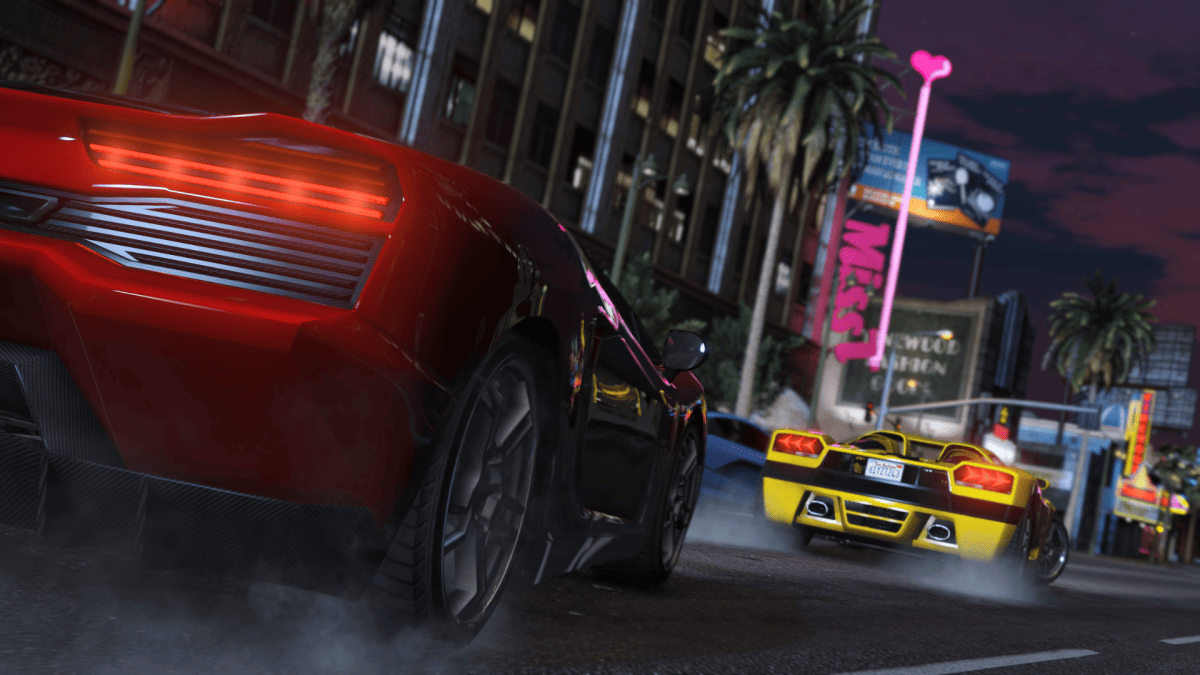
Vice City is known for its pools, ports, and canals. Leonida adds tropical lagoons, swamps, and coastlines—environments where water abounds. Ray-tracing shines here: every water surface reflection will be calculated in real-time. A car passing a flooded building creates a reflection that shifts, warps, and interacts with gameplay-generated waves.
It's a detail, but it's the detail that elevates a game from "impressive" to "incredible." When Lucia runs through a rain-soaked alley after a heist, and Vice City's neon signs reflect off the asphalt in real-time, the player feels immersion instead of just seeing it.
Urban reflections: chrome, storefronts, facades
GTA 6 trailers showcase ultra-dense urban environments: glass buildings, chrome advertising panels, shop windows. Each reflects ambient light, vehicles, shadows from moving clouds. Without ray-tracing, these reflections would be pre-rendered or approximated. With ray-tracing, they're alive.
Imagine pursuing Jason Duval through an upscale shopping district. The surrounding buildings create a labyrinth of dynamic reflections—every camera angle offers a unique, physically coherent visual composition.
Nuanced shadows and indirect lighting
Ray-tracing serves more than reflections. Shadows become incredibly detailed. A shadow cast by a streetlight on pavement isn't a flat polygon; it's a construction of light and darkness accounting for all surrounding light bounces. A dark Vice City alley creates authentically dark atmosphere, not just "bluish."
This impacts gameplay too: when robbing in darkness, ray-tracing amplifies tension by creating ultra-realistic shadow zones where enemies can hide.
Performance versus fidelity: how Rockstar balances both
Computational budget and priorities
A game engine is just a computational budget. Rockstar must choose: allocate power to more ray-tracing, or more urban density, NPC AI, particle effects?
Based on trailers and partial statements, priorities appear to be:
- Urban density and detail: Vice City and Leonida are absolutely saturated with objects, textures, architectural variety.
- Advanced AI systems: NPCs and traffic must behave emergently and realistically.
- Targeted ray-tracing: not omnipresent ray-tracing, but strategically deployed where it matters most.
- Stable frame rate: certainly 60 fps in performance mode, probably 30 fps or 40 fps in quality mode with maximal ray-tracing.
Optimization techniques: temporal reconstruction, variable quality
Unconfirmed, but Rockstar will almost certainly employ:
- Temporal reconstruction: rather than calculating every pixel each frame, the engine computes a subset and reconstructs others from previous frames. Combined with ray-tracing, this reduces load by 30-40%.
- Variable ray-tracing quality: in performance mode, ray-tracing is less aggressive (fewer rays, fewer bounces); in quality mode, it's maximal.
- Screen-space ray-tracing: for reflections near the camera (like wet ground), use on-screen data rather than complete geometry—massively cheaper.
Comparison with GTA 5 and earlier generations
GTA 5 (2013): a rasterized world
Grand Theft Auto V revolutionized gaming with its reflections and overall visual quality, but everything was rasterized. Water reflections were pre-calculated or used envmaps (static projected images). Shadows were shadow maps—discrete approximations but very efficient. It was the technological limit of its era.
GTA 6 (2026): ray-tracing and light physics
GTA 6 moves to light simulation directly inspired by physics. Reflections are dynamic and infinite (within performance limits). Shadows are **soft and physically correct**. Indirect lighting (light bouncing surface-to-surface) is no longer faked but simulated.
Result: visual fidelity approximately **2-3x superior** to GTA 5—not just in resolution or polygon count, but in light coherence and environmental credibility.
Technical challenges and Rockstar's solutions
Map size versus ray-tracing: a delicate balance
Rumors suggest Leonida is comparable or slightly smaller than Los Santos (GTA 5). It's strategic: huge map + global ray-tracing = impossible on console. Optimized map + hybrid ray-tracing = feasible.
Rockstar likely compensates by making Leonida more vertically dense (taller buildings, more explorable floors) and enriching architectural variety (tropical Keys don't resemble Port Gellhorn skyscrapers).
Ray-tracing and emergent gameplay: hidden complexity
Ray-tracing adds a layer of "physical reality" impacting gameplay. Dynamic shadows affect stealth. Reflections in a window reveal enemies. It's subtle but cumulative—each system increases behavioral immersion, not just visual.
Future perspectives: ray-tracing and beyond 2026
GTA 6 is already optimized to exploit current PS5 and Xbox Series X power. But ray-tracing isn't a destination; it's a vector. By 2030-2032, when next-next-gen consoles arrive, ray-tracing will be pervasive and effective, letting devs focus on new frontiers: granular surface simulation (individual sand grains), full-scene fluid dynamics, generative AI for content synthesis.
GTA 6 lays the groundwork. It's a milestone, not a terminus.
FAQ: Ray-tracing, performance, and GTA 6 technology
Will ray-tracing slow down GTA 6? Will we get 60 fps?
Rockstar hasn't officially announced figures. Based on current industry standards (2024-2025), GTA 6 will likely offer a 60 fps performance mode (rasterization plus light ray-tracing) and a 30 fps quality mode (maximal ray-tracing). A 40 fps option is possible on Xbox Series X, which supports this natively. Awaiting Rockstar's confirmation.
Will GTA 6 have DLSS or FSR for performance boost?
Unconfirmed. DLSS is Nvidia-proprietary (GPU-exclusive, not applicable on console). FSR (AMD FidelityFX Super Resolution) is possible on PS5 and Xbox Series X, but Rockstar hasn't announced it. They likely use proprietary temporal reconstruction or an internal RAGE solution, but that's speculation.
What's the real gameplay impact of ray-tracing?
The impact is mostly perceptual and emotional, not mechanical. You won't see a "mechanical" difference (bullet physics doesn't change). But you'll feel an atmosphere difference: a rain-soaked alley will be credible and tense rather than "pretty but fake." Urban environments resonate as real spaces, not theater sets. That's what creates psychological immersion distinguishing GTA 6.
Will GTA 6 on PC have even better ray-tracing?
No PC version has been announced for GTA 6. Rockstar prioritizes console launches, with PC ports following later. Historically, GTA 5 PC (2015) benefited from ray-tracing and graphics exceeding console versions, and it's likely GTA 6 PC, if and when it arrives, will offer more complete and aggressive ray-tracing. But that's distant, unconfirmed future.