Introduction: Beyond Simple "Random Placement"
Since Grand Theft Auto III in 2001, Rockstar Games' open worlds have captivated players with their sense of authentic life. But while GTA V already offered complex NPCs with daily routines, emotions, and contextual reactions, GTA 6 and its fictional state of Leonida reach an entirely new technical level. Rumors and analysis of official trailers (December 2023 and 2025) suggest that Rockstar Games has invested heavily in more sophisticated behavioral AI systems, capable of generating genuine emergent urban life rather than scripted simulations.
This article decodes what we know—and what we can reasonably infer—about how NPC artificial intelligence will transform the gaming experience in Vice City and beyond. No baseless speculation: only what has been analyzed, confirmed, or logically deduced from publicly available materials.
GTA V's AI Legacy: Foundations and Limitations
To understand the expected improvements in GTA 6, we first need to grasp what GTA V accomplished in 2013. The game introduced behavioral routines: each NPC had a schedule, went to work, relaxed in the evening, had specific movement habits. Their reactions were contextual: an armed NPC would fight back aggressively; a civilian would scream and run during gunfire.
However, GTA V also relied on predefined containers. Interactions were often limited to a few dialogue branches. Reactions, while varied, followed recognizable patterns. Routines rarely overlapped organically—they activated and deactivated based on streaming zones.
The RAGE engine powering GTA V was mighty, but optimized for PS3/Xbox 360 and later ported to PS4/Xbox One. GTA 6 on PS5 and Xbox Series X|S benefits from radically superior raw power, opening new horizons for behavioral density and simulated complexity.
The Redefined RAGE Engine: AI Architecture for Vice City
While Rockstar Games hasn't divulged complete technical details, analysis of trailers and official statements indicates that the RAGE engine used for GTA 6 has undergone a major overhaul. According to rumors circulating in the community (not officially confirmed), this evolution concerns:
- Increased CPU threads allocated to AI: next-gen consoles (PS5, Xbox Series X) offer more flexible multi-core architectures, allowing Rockstar to dedicate more computing power to NPC behaviors without impacting graphics performance.
- Adaptive learning systems: unconfirmed rumor suggesting that NPCs could remember player actions and adapt their behavior over time (example: fleeing from the player if they have a killer reputation).
- Increased simulation density: according to leaks, Leonida could host a significantly higher number of simultaneous NPCs than GTA V, creating the impression of a truly living city.
- NPC-to-NPC interactions independent of the player: NPCs could argue, form alliances, chase each other without direct player intervention.
However, none of these systems has been officially confirmed by Rockstar Games. They remain technical extrapolations based on visual clues from trailers and the theoretical capabilities of PS5/Xbox Series X hardware.
Daily Routines and Temporal Cycles in Leonida
One element that's virtually certain, based on continuity with GTA V and observations from trailers, is the persistence of detailed temporal cycles. In Vice City and across Leonida, day-night passes, affecting urban behavior:
- Daytime (6am-6pm): civilians go about their business, workers head to the office, children to school. Traffic is dense. Shops are open. Police presence is moderate.
- Evening (6pm-11pm): transition toward nightlife. Bars and clubs fill up. Traffic partially decreases. Criminals emerge. Illegal activity (trafficking, gangs) intensifies.
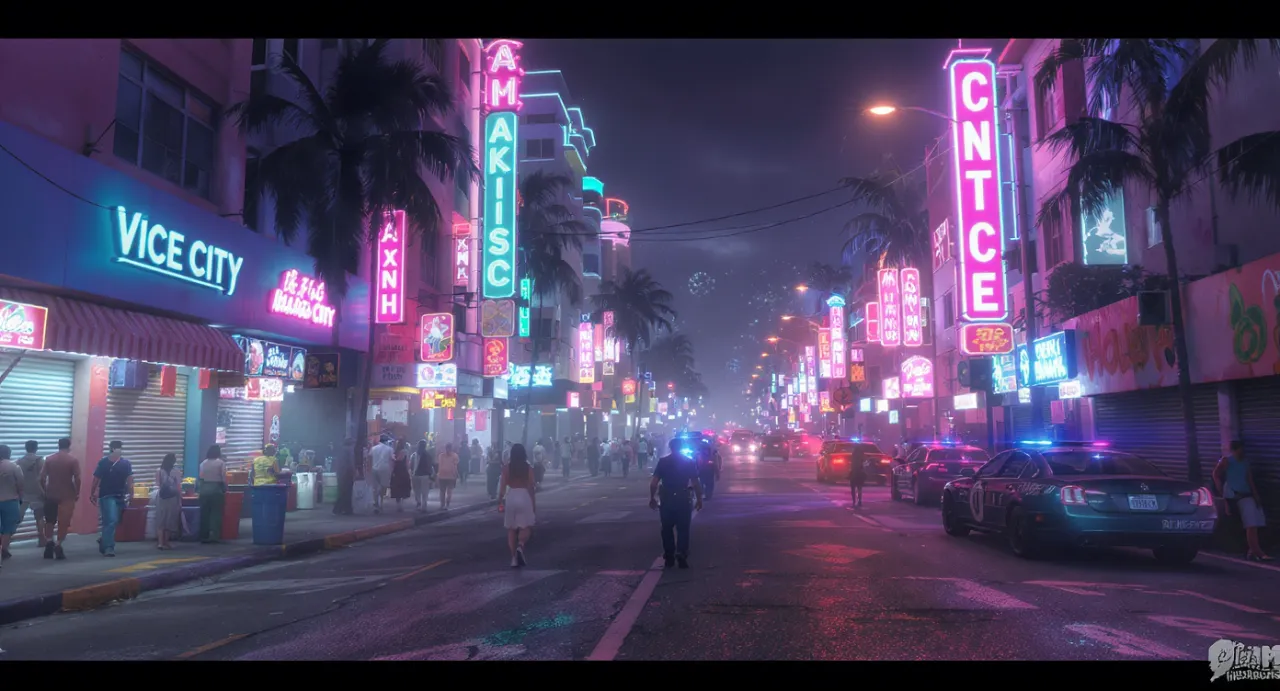
- Night (11pm-6am): Vice City deploys its synthwave and neon side. Clubs are in full swing. Less-frequented streets see the emergence of dealers, escorts, homeless. Police patrol differently.
According to rumors (unofficial), these cycles could be even more granular in GTA 6: precise hourly routines rather than simple six-hour blocks. An NPC might not just be "at the bar" but follow a detailed path: leave work at 6pm, take a taxi, arrive at the bar at 6:30pm, order a drink, chat with friends starting at 7pm, etc.
Contextual Reactions and Emotional Intelligence
An area where GTA 6 could innovate significantly concerns contextual emotional reactions of NPCs. In GTA V, reactions were binary: fear or aggression, mostly. But as computing power increases, transitions between emotional states can become more refined.
According to analysis of video clips from official trailers (which don't definitively confirm anything), we observe that:
- An attacked NPC might first try to negotiate or flee rather than immediately fight back.
- Civilians could display surprise, indignation, compassion—not just fear.
- Armed NPCs could assess the threat before opening fire: an unarmed NPC would call police rather than fight alone.
- Emotional contagion could play a role: if one NPC cries for help, neighbors run to assist; if the crowd panics, panic spreads.
Again, these behaviors are logical extrapolations based on hardware's technological capabilities, not confirmations.
Social Interactivity and Dynamic Dialogue Systems
GTA V offered limited and often comedic dialogue with NPCs (stopping someone to talk to them, generally). GTA 6 could expand this thanks to the RAGE engine's increased capabilities. Rumors (unconfirmed) suggest:
A more generous dialogue system where interactions with secondary NPCs—vendors, street criminals, ordinary civilians—vary more widely and generate opportunities for minor missions or information gathering.
During the trailers, we glimpsed Jason Duval (male protagonist) and Lucia Caminos (female protagonist and the first female protagonist of the main GTA series) interacting with various characters. While these scenes are scripted, they hint at richer dialogue than GTA V.
Moreover, the concept of dynamic reputation could play an increasing role: NPCs would distrust Jason or Lucia based on their criminal history in the sector. A trafficker might refuse to deal with a player known for massacring his colleagues.
Gangs, Factions, and Emergent Interactions
An often underestimated aspect of GTA worlds is gang dynamics. In GTA V, gangs controlled certain territories and engaged in combat with other factions. GTA 6 could amplify this by allowing gangs to:
- Conduct independent operations: robberies, trafficking, assassinations committed by NPCs without player intervention.
- Negotiate and form alliances: gangs could ally against common enemies or conflict over resource control.
- React to the player: if the player works for one gang, rival gangs chase them; if they betray, revenge follows.
- Evolve territorially: according to unconfirmed rumors, certain Vice City neighborhoods could change control over time, reflecting simulated gang wars.
Leonida, a fictional state inspired by Florida, comprises Vice City (the urban metropolis) as well as rural areas, marshes, and Keys (according to disclosed information). Each environment could harbor distinct factions with their own AI cultures.
Urban Density and Sensory Immersion of Vice City
One of GTA 6's implicit promises is a Vice City denser and livelier than ever. Images from trailers show crowded streets, diverse crowds, impressive architectural detail levels. On the AI front, this translates to:
- Increased number of active NPCs: according to rumors, density could double or triple compared to GTA V thanks to engine optimization and console improvements.
- Behavioral diversity: each NPC doesn't follow the same script. A thousand civilians on a street take a thousand slightly different paths.
- Wildlife and environment: Keys and marshes could host AI fauna (alligators, birds) adding to immersion (unconfirmed).
- AI-driven vehicles: beyond pedestrians, each circulating car is potentially driven by an NPC with its own driving AI, detecting obstacles, respecting lights, etc.
This density assumes a sophisticated optimization architecture: hierarchical streaming, deactivation of detailed behaviors off-screen, clustering distant NPCs into simplified crowds.
Police, Law Enforcement, and Wanted Systems
An AI system often taken for granted but extremely complex is that of police and law enforcement. In GTA V, cops reacted to crimes and chased you. GTA 6 could refine this by:
- Diversifying police responses: petty crimes bring patrol cars; serious crimes alert SWAT or helicopters.
- Implementing tactical intelligence: police don't mindlessly rush the player but coordinate encirclements, ambushes, logical reinforcements.
- Learning and remembering: according to unconfirmed rumors, police could adjust tactics if the player always responds with the same behavior.
- Organic patrols: cops don't teleport; they actually patrol Vice City streets, enter buildings, interrogate civilians (perhaps in the background, creating simulated police life).
Economic Ecosystem and Black Markets
A less visible but crucial aspect concerns simulated economy and black markets. GTA V sketched this with drug dealing and criminal missions. But according to unconfirmed rumors, GTA 6 could offer:
- Dynamic pricing: prices for goods and services fluctuate based on rarity, simulated demand, and player actions.
- Criminal NPC dealers: criminal NPCs who buy and sell independently, creating a functional underground economy.
- Simulated money laundering: NPCs who purchase goods to launder criminal revenue.
- Road smuggling: trucks transporting illegal merchandise that the player can intercept or rival gangs attack.
This economic ecosystem would make Vice City less a static backdrop than a living socio-economic machine.
Radio Systems and Musical Life
An element confirmed by Rockstar Games concerns the existence of distinct radio stations in GTA 6. The trailer mentioned V-Rock, a rock station. Radios offer indirect social context: an NPC in a car might listen to a specific station, influencing their mood or behavior (a hip-hop enthusiast versus a classical fan being different characters in the AI simulation).
NPCs listening to different stations could gravitate toward different social venues: rock clubs for V-Rock, hip-hop clubs for corresponding stations, etc. This adds a dimension of simulated social segmentation.
Streaming Technology and Invisible Architecture
Under the hood, GTA 6's AI relies on a sophisticated hierarchical streaming system. Here's how it works (based on established technologies and hardware capabilities):
NPCs closest to the player enjoy full AI: detailed routines, emotional reactions, dynamic interactions. With distance, AI simplifies: distant NPCs follow pre-calculated paths, very distant NPCs are grouped into non-interactive visual crowds, and those off-screen are deactivated.
This system, invisible to players but technologically complex, maintains an illusion of density and life without overloading the processor. GTA 6 could refine this hierarchy with more detail levels, allowing greater overall density.
Player Impact on Emergent Life
An implicit goal of advanced AI systems is creating emergent impacts: player actions permanently alter the world, not just the direct narrative. According to rumors (to be confirmed upon release on November 19, 2026):
- Killing a trafficker could affect simulated drug routes in the neighborhood.
- Helping a gang could strengthen it, shifting the power balance in Vice City.
- Destroying a criminal establishment could leave a socio-economic void that rival gangs attempt to fill.
- Civilians could remember the player, greet or avoid them in future encounters.
Comparison with GTA V: Generational Leaps
To contextualize expected improvements, here's a simplified comparison:
Aspect GTA V (2013) GTA 6 (2026) — Expected NPC Density ~100-150 active NPCs ~200-300 Emotional States Binary (fear/aggression) Spectrum with transitions Routine Granularity 6-hour blocks Hourly or finer NPC Memory Session-based Potentially persistent (rumored) Independent NPC Actions Limited Expanded (gang ops, crime, etc.) Police Tactics Pattern-based Adaptive (rumored) World Impact Persistence Mostly temporary Potentially lasting (unconfirmed)Optimization and Performance Balancing
Enhanced AI doesn't come without cost. Rockstar must balance ambitious systems with smooth gameplay at 60fps on console hardware. Expected optimization strategies include:
- Level-of-Detail (LoD) Systems: NPCs closer to camera receive full behavior trees; distant ones use simplified states.
- Asynchronous Processing: background AI calculations don't block the frame; results update asynchronously.
- Cluster Simplification: large crowds are processed as groups rather than individuals.
- Predictive Streaming: the engine anticipates where the player will go and pre-loads relevant NPC data.
Narrative Integration: NPCs as Story Elements
Beyond technical systems, GTA 6's AI serves narrative purposes. The game features Jason Duval and Lucia Caminos as protagonists in a story about crime and ambition. Advanced NPC AI means:
- Dynamic Faction Relations: NPCs remember your choices and change allegiances accordingly.
- Emergent Mission Opportunities: rather than only receiving missions from story figures, you might overhear NPC conversations offering side opportunities.
- Social Consequence: harming an NPC's friend creates genuine social friction, not just a mission marker.
- Character Depth: secondary characters feel like people with lives, not quest dispensers.
Anticipated Player Experience
When GTA 6 launches, players should expect Vice City to feel fundamentally more alive than previous entries. You'll witness:
- NPCs conducting complex daily lives without your involvement
- Gangs waging territory wars you can influence but don't control
- Crime that exists independently of your criminal career
- A city that adapts to your notoriety and reputation
- Emergent stories arising from NPC interactions you couldn't predict
This isn't about flashy cinematic moments—it's the subtle richness of a world that feels genuinely inhabited.
Official Confirmations and Remaining Mysteries
What Rockstar Games has officially confirmed about GTA 6 AI remains minimal. We know:
- The game exists and launches November 19, 2026
- It features Jason Duval and Lucia Caminos
- It's set in Leonida, inspired by Florida
- Vice City returns as the primary location
- Multiple radio stations exist including V-Rock
Everything else—adaptive learning, emergent gang wars, expanded emotion systems—remains informed speculation based on technical capabilities and industry trends.
The Future of Open-World AI
GTA 6 represents a watershed moment for AI in open-world games. Whether the rumored features materialize or not, the game's scale and budget position it as an industry benchmark. Developers will watch closely to understand how far NPC simulation can extend without compromising performance or player experience.
Vice City and Leonida's inhabitants won't be truly intelligent—they'll be sophisticated simulations creating an illusion of life. But that illusion, if done well, transforms how we experience interactive worlds.
Conclusion: A City That Breathes
Leonida and Vice City in GTA 6 appear poised to offer something long-promised but rarely delivered: a living, breathing city that evolves independent of the player. Through refined behavioral AI, emergent NPC interactions, and persistent world systems, Rockstar Games aims to blur the line between simulation and reality.
Will it achieve this? We'll know November 19, 2026. But based on available evidence, the foundations are being laid for open-world AI that finally matches the ambitions players have held since the earliest GTA games.
Vice City doesn't just exist in GTA 6—it lives.